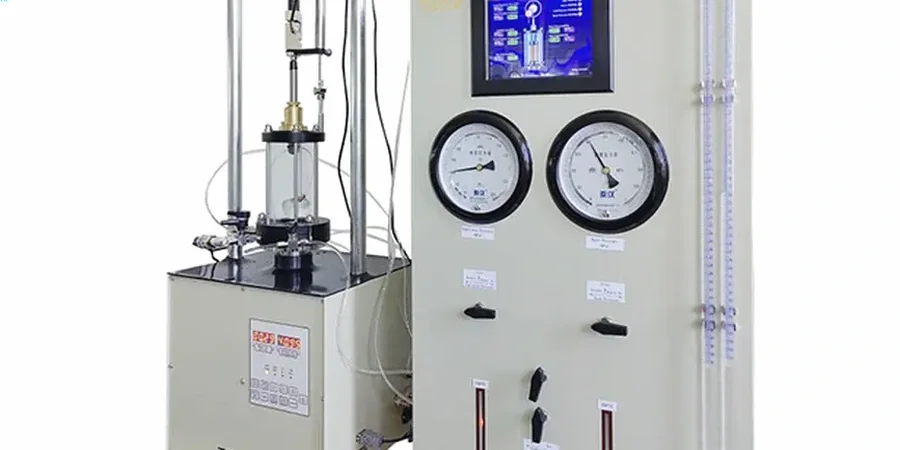
The Salt River Valley’s subsurface hides a legacy of cemented alluvium and caliche layers that behave unlike ordinary granular soils—peak friction angles can exceed 42° in undisturbed samples from the Mesa Terrace deposits. In Phoenix, where basin-and-range tectonics leave residual stresses locked into Pleistocene gravels, a standard direct shear simply won’t capture the full effective-stress path needed for deep foundation design. Our triaxial test program runs consolidated-undrained and consolidated-drained stages on Shelby tube specimens recovered from depths of 15 to 80 feet, targeting the very hardpan horizons that control pile tip capacity across the Deer Valley and Ahwatukee corridors. We execute the protocols under ASTM D4767 because Phoenix engineers routinely face the contradiction of high SPT N-values alongside collapsible fabric—a condition that demands pore-pressure measurement during shear, not after.
A CU triaxial on cemented desert alluvium often reveals an apparent cohesion component that a friction-only bearing capacity equation would miss entirely.
Scope of work
Local ground factors
We often see Phoenix projects where shallow footing designs rely on friction angles derived from SPT correlations—and those correlations were calibrated for silica sands, not the gypsiferous, partially cemented mixtures that dominate the Salt River Valley. The consequence shows up after the first monsoon season: differential settlement triggered by dissolution of soluble cement at the wetting front, which a drained triaxial test would have flagged through volume-change measurements during shear. The bigger liability lies in ignoring the cohesion intercept that caliche-rich horizons carry out. If you omit that 8–12 psi c' value because someone ran a quick UU test on a disturbed sample, you end up oversizing footings or adding piles that the native formation never needed. In Phoenix’s seismic setting—ASCE 7 assigns Site Class C or D to most basin profiles—the cyclic degradation of cementation under repeated loading is another failure mode that only a multi-stage triaxial with pore-pressure monitoring can realistically evaluate before construction begins.
Standards used
ASTM D4767 – Consolidated Undrained Triaxial Compression Test, ASTM D7181 – Consolidated Drained Triaxial Compression Test, ASTM D2850 – Unconsolidated Undrained Triaxial Compression Test, ASCE 7-22 – Seismic Site Classification input parameters, IBC 2021 – Foundation design strength requirements
Related services
Consolidated-Undrained (CU) with Pore Pressure
Three specimens consolidated at different effective stresses, sheared undrained with mid-plane pore-water pressure measurement. We deliver Mohr-Coulomb envelopes in both total and effective stress, plus stress path plots (q-p') that show whether the soil contracts or dilates during shear—a decisive factor for liquefaction assessment in the saturated lenses found beneath the Salt River channel.
Consolidated-Drained (CD) for Long-Term Stability
Slow shearing at 0.001–0.005 in/min allows full pore-pressure dissipation throughout the test. This protocol yields the true drained friction angle and any cohesion from cementation, which are the parameters required for retaining wall design, slope stability analysis on the Phoenix Mountains Preserve perimeter, and settlement prediction under sustained dead loads.
Typical parameters
Questions and answers
How much does a triaxial test program cost in Phoenix?
A standard three-specimen CU or CD set with full reporting runs between US$1,660 and US$2,930, depending on specimen depth, sampling method, and whether multi-stage loading is required. The range covers trimming, saturation, consolidation, shear, and data reduction with stress path plots. Expedited turnaround adds a surcharge.
What soil conditions in Phoenix make a triaxial test necessary instead of direct shear?
Phoenix basin soils frequently contain caliche cementation, gypsum veins, and interbedded gravels with clay seams—all of which create a true cohesion component and pore-pressure response that direct shear boxes cannot measure. When the design requires effective-stress strength parameters for drained loading or seismic analysis, the triaxial cell is the only apparatus that provides controlled drainage and pore-water pressure monitoring during shear.
How long does it take to get triaxial test results?
Our standard turnaround for a complete three-specimen triaxial set is 5 to 7 business days from the moment the undisturbed samples arrive at the lab. Consolidated-drained tests take longer because the shear stage must proceed slowly enough to prevent pore-pressure buildup; we typically quote 7 business days for CD protocols. We carry out preliminary friction angles within 48 hours upon request. More info.