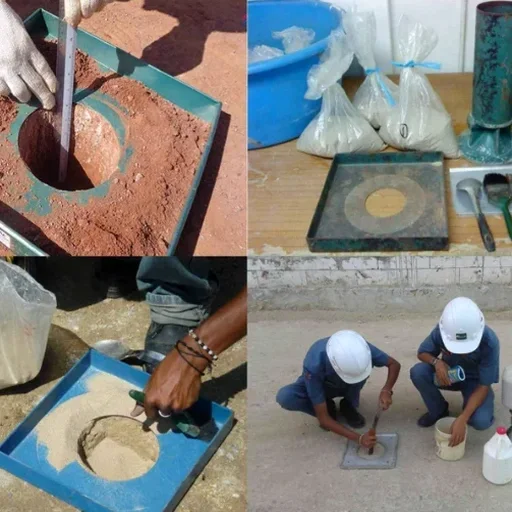
Phoenix brings a unique set of challenges to earthwork—summer temps above 110°F and arid, granular soils that can shift from dry powder to flash-flood slurry in minutes. The field density test (sand cone method) is how we verify compaction on site before that slab goes down. Over the years, our team has run thousands of these tests across the Valley, from infill lots near downtown to large graded pads in Buckeye. The sand cone gives us a direct, reliable density reading without needing a nuclear gauge license, which matters on tight urban jobs or school sites. For deeper stratigraphy when the fill is thick, we often pair it with SPT drilling to confirm what lies beneath the compacted layer. In Phoenix, where caliche lenses and cemented silts hide under seemingly uniform sand, knowing the full profile saves headaches later.
A sand cone test tells you in fifteen minutes whether that lift of fill will carry a building for fifty years.
Scope of work
Local ground factors
Phoenix sits at roughly 1,100 feet elevation in a basin that hasn't seen a major earthquake since the 1887 Sonora event—but that doesn't mean we ignore seismic settlement potential in loose fills. The bigger everyday risk is differential movement from poorly compacted backfill over utility trenches. We see it constantly in older neighborhoods like Arcadia, where alleyway trench patches sink three inches after one monsoon season. A skipped field density test (sand cone method) on a sewer trench backfill can mean cracked pavement, tripping hazards, and a repair bill that dwarfs the original testing cost. In Maricopa County, building departments enforce IBC Chapter 18 compaction verification, and inspectors routinely ask for sand cone reports on commercial projects. Salt River Project canals and retention basin earthwork carry their own spec—lose a basin embankment to piping failure and you're dealing with flood liability on top of structural damage.
Standards used
ASTM D1556 – Standard Test Method for Density and Unit Weight of Soil in Place by Sand-Cone Method, ASTM D698 / D1557 – Standard Test Methods for Laboratory Compaction Characteristics, IBC Chapter 18 – Soils and Foundations; compaction verification requirements
Related services
Structural fill inspection
Sand cone testing on building pads, footings, and slab-on-grade prep. We verify each lift meets spec before the concrete crew arrives.
Utility trench backfill
Compaction verification on water, sewer, and storm drain trenches. Critical for street patches and parking lot subgrade in Phoenix right-of-way work.
Retention basin earthwork
Density control on basin embankments and outlet structures. SRP and city drainage specs demand documented compaction for flood control facilities.
Aggregate base course
Testing ABC compaction under rigid and flexible pavements. We match field density to lab Proctor on the same material batch.
Typical parameters
Questions and answers
How much does a field density test (sand cone method) cost in Phoenix?
For a standard sand cone density test in the Phoenix metro area, you're generally looking at US$110 to US$160 per point, depending on how many points we're hitting in a day and how far the site is. Mobilization is separate and scales with distance from our Phoenix base. Volume discounts usually kick in around ten or more tests on the same visit.
How long does a sand cone test take on site?
From setup to final weight, plan on about fifteen to twenty minutes per test hole. The excavation and sand pouring go fast—maybe five minutes—but the weighing, moisture content determination, and calculation take a bit more time. On a typical Phoenix pad inspection, we can run six to eight points in a morning.
Can you use the sand cone method on gravelly soils common in Phoenix?
ASTM D1556 limits the method to soils with maximum particle size around 1.5 inches. Phoenix area soils often have desert pavement and coarse gravel, especially on older alluvial fans. If the gravel fraction is too high, we switch to a water replacement or drive-cylinder method. We'll let you know during our initial subgrade walk-through.
Do Phoenix building departments accept sand cone results for compaction sign-off?
Yes—sand cone test reports following ASTM D1556 are standard for compaction verification in Maricopa County and all Phoenix-area municipalities. We carry out signed, dated reports that reference the lab Proctor curve and project specs. Most inspectors accept them without issue as long as the field density meets the specified relative compaction percentage.