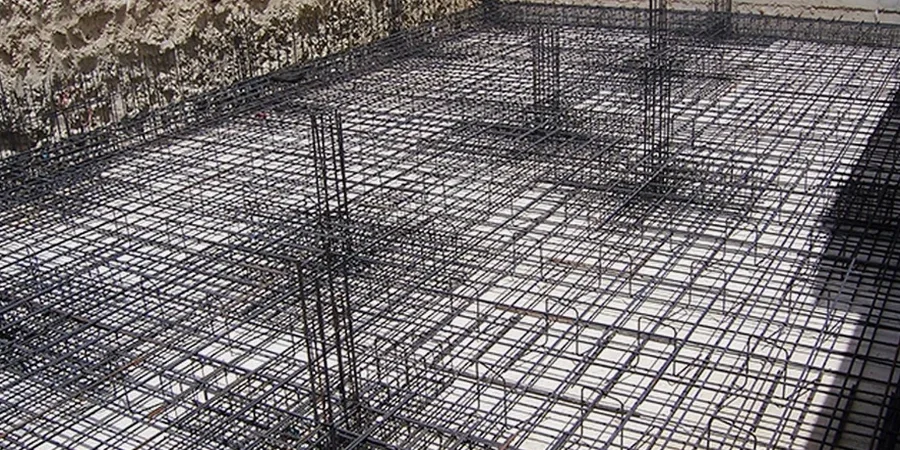
A concrete pump truck extends its boom over the rebar grid, placing the mat in one continuous pour. That is what a raft foundation site looks like in Phoenix. The crew works fast because the 110-degree heat accelerates the set time. We see this every week across the Valley. A mat foundation spreads the structural load across the entire footprint, which is critical when you are dealing with the variable soils found between North Mountain and South Mountain. Before we finalize the thickness and reinforcement, we often correlate subsurface data from an SPT drilling program to confirm bearing capacity at depth. It is the only way to design a slab that handles differential settlement in this basin.
A raft foundation is not just a thick slab. It is a structural system that turns the entire building footprint into one rigid unit that moves with the soil.
Scope of work
Our design integrates several key elements:
- Ribbed mat systems with deepened perimeter beams to bridge soft spots
- Post-tensioned slabs that actively resist expansive soil uplift
- Void forms beneath grade beams where heave potential is extreme
- Reinforcement layouts that meet ACI 318 detailing for seismic ductility
Local ground factors
A site near the Salt River bed and a site up in Desert Ridge will have completely different soil profiles, even though both are in Phoenix. The river corridor has loose sandy alluvium with a shallow water table. Desert Ridge sits on harder caliche with expansive clay lenses. If you apply the same generic mat foundation thickness to both, one will settle and the other will heave. The real risk is ignoring the micro-zonation. We have seen slabs designed with a uniform 12-inch thickness fail within three years because the geotech report was too sparse. Differential movement of half an inch can shear interior partition walls and rupture plumbing lines. In a city with 300-plus days of sun but intense seasonal rain, the wet-dry cycle is brutal on reactive soils. A mat foundation has to be tuned to the specific subgrade, not the zip code.
Watch the video
Standards used
IBC 2021 (International Building Code), ASCE 7-22 Minimum Design Loads, ACI 318-19 Building Code for Structural Concrete, ASTM D1586 Standard Penetration Test, ASTM D2487 Soil Classification
Related services
Geotechnical Investigation
We drill and sample to characterize expansive potential, caliche hardness, and bearing strata before a single line of structural design is drawn.
Soil-Structure Interaction Modeling
We use finite element software to simulate how the mat will behave under dead, live, and seismic loads, matching the actual soil springs from field tests.
Post-Tensioned Slab Design
For highly expansive sites, we design PT mat foundations that actively compress the soil and resist seasonal heave cycles common in the Phoenix area.
Construction Support and QA/QC
We review rebar placement, concrete mix designs, and pour procedures to handle the extreme temperatures of Arizona summer construction.
Typical parameters
Questions and answers
What does a raft/mat foundation design cost in Phoenix?
Engineering design fees for a mat foundation in Phoenix typically range from US$900 to US$4,130 depending on the building footprint, soil complexity, and whether post-tensioning is required. A simple single-story slab on moderate soil will be at the lower end. A large commercial mat on expansive clay with finite element modeling and multiple design iterations will be higher. We carry out a fixed-fee proposal after reviewing the geotechnical report and architectural plans.
When is a mat foundation better than isolated footings in Phoenix?
A mat foundation makes sense when the soil bearing capacity is below 2,000 psf, when expansive clay is present across the site, or when the column loads are heavy and closely spaced. In Phoenix, we often recommend mats for tilt-up warehouses, mid-rise condos, and any structure where differential settlement could crack finishes. The mat bridges soft spots that isolated footings cannot handle individually.
Does the Phoenix heat affect mat foundation construction?
Yes, significantly. Concrete can reach its initial set in under 90 minutes when the ambient temperature exceeds 105 degrees. We specify retarders, chilled mixing water, and early-morning pours to manage this. The subgrade also needs to be pre-wetted so it does not suck moisture out of the fresh concrete. Our construction-phase support covers these thermal controls specific to the Sonoran Desert climate.