Foundation design in Phoenix demands a clear understanding of the subsurface—and the city’s geology shifts dramatically from one district to the next. A site near the Salt River in the Rio Salado corridor often reveals layers of unconsolidated alluvium with high groundwater influence, whereas a parcel up in Desert Ridge or north of the Central Arizona Project canal sits atop thick caliche deposits that can resist a shovel but still hide collapsible silts beneath. Both are in Phoenix, but the required bearing strategy, excavation method, and even the sampling protocol differ substantially. A detailed soil mechanics study decodes these contrasts before the first yard of concrete is poured. We run laboratory index tests under ASTM D2487 to classify the material and pair the results with field data, ensuring that the geotechnical model reflects the actual basin-fill stratigraphy of the Salt River Valley, not a generic desert assumption. For projects near the Phoenix Mountains Preserve, where weathered granite residuum appears within a few feet of grade, we often combine the mechanics program with a seismic refraction survey to map the depth to bedrock and avoid surprises during excavation.
Phoenix soils do not forgive assumptions—what looks like competent caliche from the surface often masks collapsible silts that require a mechanics-based foundation redesign.
Scope of work
Local ground factors
A practical observation from years of drilling in the Valley: the most expensive geotechnical failures we have investigated in Phoenix rarely come from a single bad soil layer—they come from the interface between two materials that behave completely differently when wetted. The classic case is a footing bearing on stiff caliche with a lens of expansive clay just below the influence zone. During the monsoon, water migrates along the caliche-clay contact, the clay swells, and the slab heaves unevenly. A soil mechanics study that runs Atterberg limits and swell-consolidation tests on samples from both the bearing stratum and the transition zone catches this condition early. The ASCE 7 load combinations and the IBC chapter 18 requirements for expansive soils then guide the mitigation—whether that means over-excavation, moisture conditioning, or a structural floor system that decouples the slab from the ground. In a city that averages over 300 sunny days a year but still delivers intense seasonal precipitation, that moisture-sensitivity analysis is not optional.
Standards used
ASTM D2487 – Standard Practice for Classification of Soils for Engineering Purposes (Unified Soil Classification System), ASTM D1586 – Standard Test Method for Standard Penetration Test (SPT) and Split-Barrel Sampling of Soils, ASCE 7 – Minimum Design Loads and Associated Criteria for Buildings and Other Structures, IBC Chapter 18 – Soils and Foundations (governing expansive soil and collapsible soil provisions), ASTM D4767 – Standard Test Method for Consolidated Undrained Triaxial Compression Test for Cohesive Soils
Related services
Field investigation and sampling in Phoenix basin-fill deposits
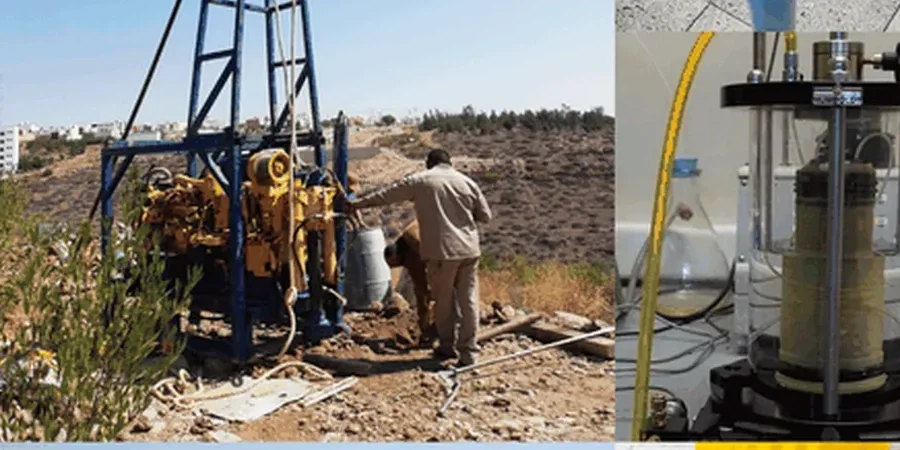
We mobilize hollow-stem auger rigs across the metro area—from Ahwatukee to Deer Valley—to perform SPT sampling per ASTM D1586, extract undisturbed Shelby tubes through caliche and cemented sands, and log the stratigraphy with an emphasis on the contact between Quaternary alluvium and the older basin-fill units that control bearing capacity.
Laboratory testing and geotechnical parameter derivation
Index testing, triaxial shear, consolidation, and sulfate content analysis run in our accredited lab, producing the effective stress parameters and settlement predictions that structural engineers need for footing, mat, or deep foundation design in Phoenix’s variable subsurface.
Typical parameters
Questions and answers
What does a soil mechanics study in Phoenix typically cost for a single-family residential lot?
For a standard single-family lot in the Phoenix metro area—including a drilling crew mobilization, one or two borings to 15 or 20 feet, SPT sampling, laboratory classification and shear testing, and a geotechnical report with foundation recommendations—the cost generally falls between US$3,460 and US$5,940. The final number depends on access constraints, depth of sampling required, and whether chemical testing for sulfate attack on concrete is specified by the structural engineer.
How do you handle the hard caliche layers that are common across Phoenix?
Caliche is one of the defining geotechnical challenges in the Phoenix basin. We use hollow-stem auger rigs with carbide-tipped cutting bits to penetrate the cemented crust, and we extract undisturbed samples where possible to run unconfined compression tests on the caliche itself. The real question is what sits below the caliche—often loose silts or expansive clays—so we always sample through the full depth of the foundation influence zone rather than stopping at refusal. Where caliche is massive and continuous, it can serve as an excellent bearing stratum, but the geotechnical report must confirm its lateral continuity across the footprint.
What is the difference between a soil mechanics study and a standard geotechnical report?
A standard geotechnical report for a Phoenix building permit typically includes soil classification, bearing capacity, and general foundation recommendations. A soil mechanics study goes further: it quantifies the stress-strain behavior of the soil through triaxial or direct shear testing, measures consolidation and swell parameters, and derives the effective shear strength values that structural engineers need for advanced foundation design, slope stability analysis, or retaining wall calculations. When a project involves deep excavations, mat foundations, or sites with problematic soils, the mechanics-level parameters become essential for a safe and economical design.