The Sonoran Desert doesn't reveal its secrets from the surface. In Phoenix, where the valley floor conceals ancient river channels, cemented caliche horizons, and pockets of collapsing soil, a standard boring log often misses critical transitions that only direct observation can capture. We deploy exploratory test pits across Maricopa County to expose the stratigraphy in full vertical section, letting our geotechnical team map changes in cementation, moisture, and grain fabric that govern bearing capacity and excavation stability. When designing foundations in the Salt River Valley—where summer monsoon rains can transform dry arroyos into torrents in minutes—understanding how near-surface soils react to sudden saturation becomes a construction-phase cost control measure. For deeper profiling beyond the practical limits of an open excavation, we pair test pit observations with targeted CPT testing to extend the stratigraphic model downward without losing resolution.
A two-hour test pit excavation in Phoenix caliche can save weeks of foundation redesign by revealing cemented layers that standard borings classify as uncemented.
Scope of work
Local ground factors
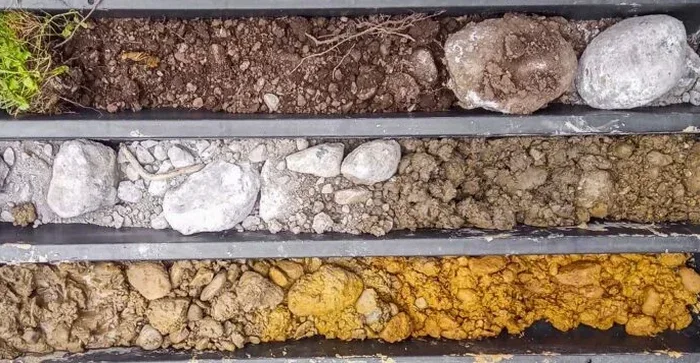
A custom home builder in Paradise Valley excavated footings to 5 feet and hit hard caliche, assumed it was bedrock, and poured. Eighteen months later, monsoon infiltration dissolved the cementation along a fracture network beneath the footing, and the southwest corner settled 1.4 inches. The problem wasn’t the caliche—it was the untreated collapsible silt lens that the caliche cap had hidden from view. A single exploratory test pit would have exposed the full section: a 2-foot caliche roof over 4 feet of low-density silt that loses 12% of its volume upon wetting. Phoenix basin soils are full of these traps: buried arroyo channels in Ahwatukee, reworked tailings in the old mining corridors near Superior, and expansive clay seams in the Laveen area that swell vertically against slab-on-grade construction. Direct visual inspection from a pit wall catches what a split spoon misses, and in a city where the frost line doesn’t exist but the wetting front reaches 8 feet down during an active monsoon, the failure mechanism is almost always water-triggered.
Standards used
ASTM D2488: Standard Practice for Description and Identification of Soils (Visual-Manual Procedure), ASTM D1556: Standard Test Method for Density and Unit Weight of Soil in Place by Sand-Cone Method, OSHA 29 CFR 1926 Subpart P: Excavation and Trenching Safety
Related services
Test Pit Excavation and Logging
Tracked excavator mobilization with OSHA-compliant shoring, direct in-pit logging by an engineering geologist, and high-resolution photo panels of each pit wall with scale reference.
In-Situ Density Testing
Sand cone or drive cylinder density measurements at bearing elevation within the pit, providing field density for compaction verification or natural state characterization.
Undisturbed Block Sampling
Carved block samples from cohesive strata for laboratory strength and compressibility testing, preserving soil fabric that would be destroyed by conventional tube sampling.
Caliche and Hardpan Evaluation
Point load index testing and Schmidt hammer profiling on cemented caliche horizons to quantify degree of cementation and predict dissolution risk under long-term wetting.
Typical parameters
Questions and answers
How much does an exploratory test pit cost in the Phoenix area?
For a typical residential or light commercial project in the Phoenix metro, a single exploratory test pit with full logging and a summary report generally ranges from US$540 to US$910, depending on depth, access constraints, and whether shoring is required. Sites with dense caliche or very coarse river gravel that slow excavation progress may run toward the upper end of that range.
How deep can you go with a test pit in Phoenix desert soils?
In the basin-fill deposits that dominate the Phoenix valley, a standard tracked excavator reaches 12 to 14 feet before practical limits set in—bucket reach, spoil pile clearance, and shoring requirements. Caliche layers sometimes require a ripper tooth and slow progress considerably. For depths beyond 14 feet, we recommend transitioning to CPT or SPT borings to extend the profile.
Can you excavate a test pit in caliche without blasting or hammering?
Most Phoenix caliche can be ripped with a single-tooth ripper on a mid-size excavator without resorting to pneumatic hammering or blasting, though progress slows significantly in the hardest Stage IV to V caliche horizons found in the northern Scottsdale and Carefree areas. We assess rippability during the first few feet and adjust the excavation plan accordingly.