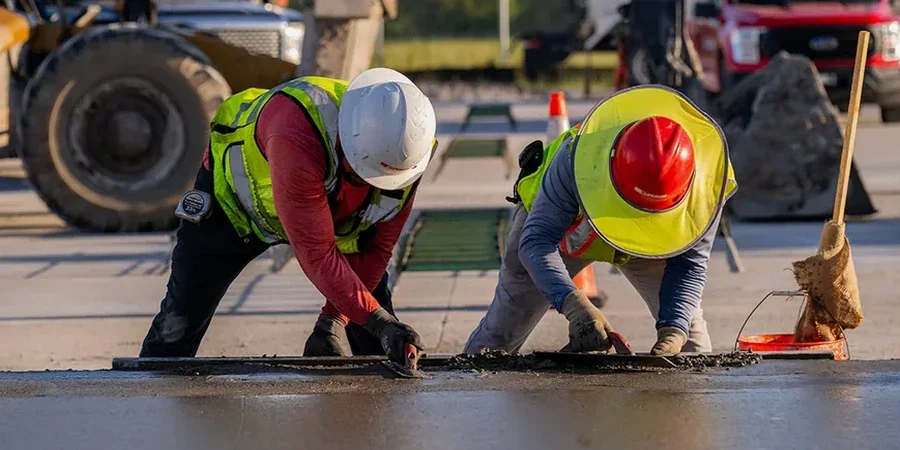
Phoenix sits on a complex alluvial basin where the upper soil profile is dominated by coarse-grained sands, gravels, and cemented caliche layers that can mislead a standard site investigation. The city’s average summer pavement surface temperatures exceed 150°F, and the diurnal temperature swing in the Valley of the Sun can top 40°F, introducing significant curling and joint stress in rigid pavement design. This isn’t just about concrete thickness—it’s about understanding how a stiff slab interacts with a desert subgrade that may soften after monsoon rains or shrink during extended drought. Our lab team focuses on the geotechnical parameters that feed directly into the AASHTO 1993 and MEPDG models used across Maricopa County, ensuring the pavement structure can handle everything from light-rail corridors to heavy-haul industrial yards. Before finalizing the slab geometry, we often pair the subgrade investigation with a CBR road test to calibrate the foundation stiffness values that drive the design.
A rigid pavement slab in Phoenix doesn’t just carry traffic—it must survive daily thermal warping stresses that rival the loading from a 40-ton truck.
Scope of work
Local ground factors
The core piece of equipment we deploy for a rigid pavement design investigation in Phoenix is a truck-mounted hollow-stem auger rig capable of penetrating cemented caliche without washing out fines. We extract thin-wall Shelby tubes from depths of 3 to 10 feet below the proposed subgrade elevation—this is the zone that controls slab support, especially where the groundwater table sits deeper than 50 feet and doesn’t mask the true moisture-suction profile. Skipping the tube sampling and relying on SPT blow counts alone is a mistake: caliche can yield N-values over 50 while hiding a collapsible silt lens just beneath it. In the lab, we run the one-dimensional swell and collapse test (ASTM D4546) on any material with a dry density below 90 pcf, because a differential movement of half an inch across a panel will initiate a transverse crack long before the design ESALs are reached.
Standards used
AASHTO Guide for Design of Pavement Structures (1993 & MEPDG), ASTM D1196 / D1195 (plate bearing for k-value), ASTM D4546 (swell/collapse potential of desert soils), ASTM C78 (concrete flexural strength), Maricopa County DOT Standard Specifications Section 400
Related services
Subgrade Support Characterization
We determine the modulus of subgrade reaction (k-value) through in-situ plate load testing (ASTM D1196) and back-calculation from laboratory resilient modulus, accounting for the loss of suction during monsoon season. The deliverable includes a k-value map across the project footprint, not a single averaged number.
MEPDG Input Parameter Development
For projects requiring Mechanistic-Empirical analysis, we carry out Level 1 or Level 2 inputs including the non-linear resilient modulus coefficients (k1, k2, k3), the coefficient of thermal expansion for the concrete mix, and the site-specific climatic file linked to Phoenix Sky Harbor weather data.
Typical parameters
Questions and answers
What is the typical cost range for a rigid pavement design geotechnical study in Phoenix?
For a standard commercial or industrial project in the Phoenix metro area, the geotechnical investigation supporting a rigid pavement design typically falls between US$1,980 and US$5,380. The final cost depends on the number of borings, the depth of caliche encountered, and the extent of laboratory resilient modulus or swell testing required.
How does the Phoenix heat affect rigid pavement design assumptions?
The extreme surface temperatures and daily thermal gradients in Phoenix induce slab curling that must be checked against traffic loads. We use a temperature differential of +2.5 to +3.0 degrees Fahrenheit per inch of slab thickness for daytime conditions, which often controls the required slab thickness more than the traffic loading alone. Joint design and concrete coefficient of thermal expansion become critical parameters.
Do you test the soil-cement reaction for sulfate attack?
Yes, we run water-soluble sulfate tests (ASTM D516) on soil samples from the subgrade contact plane. In Phoenix, particularly near agricultural legacy areas or certain Salt River deposits, sulfate concentrations can exceed 0.10 percent by weight, which triggers the requirement for sulfate-resistant cement (Type V) or a blended mix to protect the slab underside.
What is the difference between a k-value and a CBR for rigid pavement?
A CBR is an empirical penetration test originally developed for flexible pavements, while the modulus of subgrade reaction (k-value) is the specific foundation parameter used in Westergaard’s rigid pavement theory. We derive the k-value from plate load tests or resilient modulus testing, not from simple CBR correlations. Using a converted CBR instead of a measured k-value can under-design the slab in Phoenix’s stiff but moisture-sensitive soils. More info.