The difference between building a retaining wall near the Phoenix Mountains Preserve versus the Salt River floodplain comes down to how the soil reacts to moisture and lateral pressure. Up in the foothills, you are often dealing with dense caliche—cemented calcium carbonate layers that can be harder than concrete during excavation but brittle under concentrated loads. Down in the central valley and toward Tempe, the alluvial deposits contain interbedded silts and clays with a collapse potential that we must quantify before designing the stem and heel. Our lab has analyzed hundreds of samples from across the Valley, and what we see repeatedly is that the standard textbook approach for granular backfill doesn't account for the shrink-swell behavior of local soils when monsoon rains hit. A wall that looks stable on paper will tilt or crack if the active earth pressure isn't adjusted for the actual friction angle of the native material. We also coordinate with deep excavation monitoring when the wall is part of a larger basement cut in downtown Phoenix, where adjacent structures limit allowable deflection.
Phoenix soils demand retaining walls designed for the monsoon cycle—hydrostatic pressure and expansive clay behavior change the entire load case in a single afternoon storm.
Scope of work
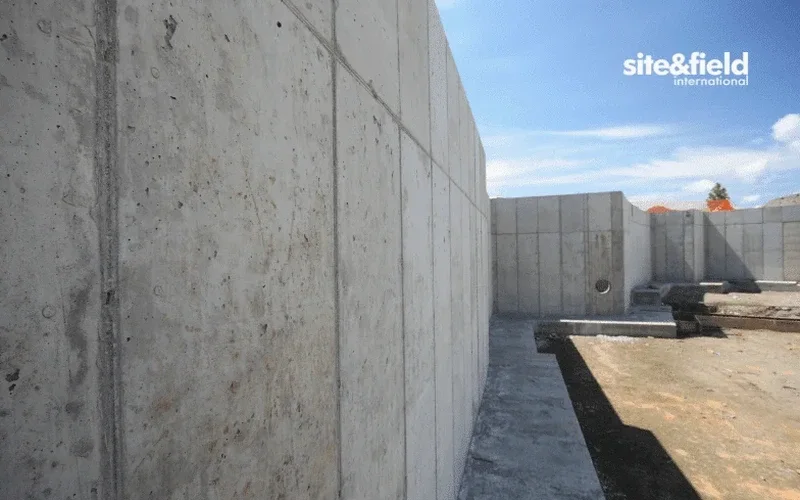
Local ground factors
Phoenix sits at an elevation of 1,086 feet and experiences a recorded history of moderate seismicity—the 1887 Sonoran earthquake, estimated at magnitude 7.6, caused damage as far north as the Salt River Valley and is a reminder that the Basin and Range province is not tectonically dead. A retaining wall design that ignores seismic earth pressure increment is non-compliant with ASCE 7-22 Section 11.8.3, which requires a pseudo-static analysis adding a horizontal component to the active wedge. Beyond seismic load, the biggest operational risk we see in the Valley is the combination of collapsible silty soils at the footing level and uncontrolled surface irrigation runoff that saturates the backfill from above. When the soil collapses, the wall loses passive resistance at the toe and rotates forward, often pulling away from the upper terrace or sidewalk. We mitigate this with pre-wetting and compaction verification, plus a reinforced concrete leveling pad that bridges small voids. Differential settlement between the wall and adjacent flatwork is another common failure mode we address by specifying expansion joints and compacted aggregate piers under the approach slab.
Standards used
ASCE 7-22 Minimum Design Loads and Associated Criteria for Buildings and Other Structures, IBC 2021 International Building Code – Chapter 18 Soils and Foundations, ASTM D3080 Standard Test Method for Direct Shear Test of Soils Under Consolidated Drained Conditions, ASTM D6913 Standard Test Methods for Particle-Size Distribution (Gradation) of Soils Using Sieve Analysis, AASHTO LRFD Bridge Design Specifications Section 11 (when adjacent to transportation infrastructure)
Related services
Geotechnical Investigation for Retaining Walls
We drill and sample at the wall alignment to determine stratigraphy, shear strength parameters, and groundwater conditions. The report includes bearing capacity, sliding and overturning checks, and lateral earth pressure diagrams ready for the structural engineer to pick up.
Construction-phase QA and Wall Monitoring
During backfill placement, we perform nuclear density testing and observe the drainage system installation. For walls over 10 feet, we can install inclinometer casings and survey targets to track deflection during the first monsoon season after completion.
Typical parameters
Questions and answers
What is the typical cost range for retaining wall design in Phoenix?
For a standard cantilever wall with a retained height between 4 and 10 feet, the geotechnical investigation and design package typically falls between US$1,070 and US$4,480, depending on the number of borings, lab testing required, and whether the wall is in a high-seismic design category that requires additional analysis.
How do caliche layers affect retaining wall footing design?
Caliche can carry out excellent bearing capacity when it is massive and continuous, but it is often irregular and fractured in the Phoenix area. We always probe below the footing elevation to confirm there isn't a soft seam underneath a hard caprock. If the caliche is thin and underlain by collapsible silt, we either remove it or extend the footing depth to bear on competent material, and we adjust the sliding resistance calculation because the caliche-on-silt interface can be a failure plane.
Do I need a drainage system behind a retaining wall in the desert?
Absolutely. Even in Phoenix's arid climate, monsoon storms and landscape irrigation can saturate the backfill. Without a drainage blanket and weep holes, hydrostatic pressure builds up and adds a triangular load distribution that most walls are not designed to handle. We specify a 12-inch minimum gravel drain with a filter fabric wrap and 4-inch schedule 40 PVC weeps at 6-foot centers as a minimum.
What seismic provisions apply to retaining walls in Arizona?
Under ASCE 7-22, retaining walls in Maricopa County must be designed for a pseudo-static seismic increment unless they qualify for an exemption based on low height and site class. We calculate the seismic active earth pressure coefficient using the Mononobe-Okabe method, with a horizontal acceleration typically between 0.10g and 0.15g depending on the site-specific spectral response acceleration from the USGS hazard maps.