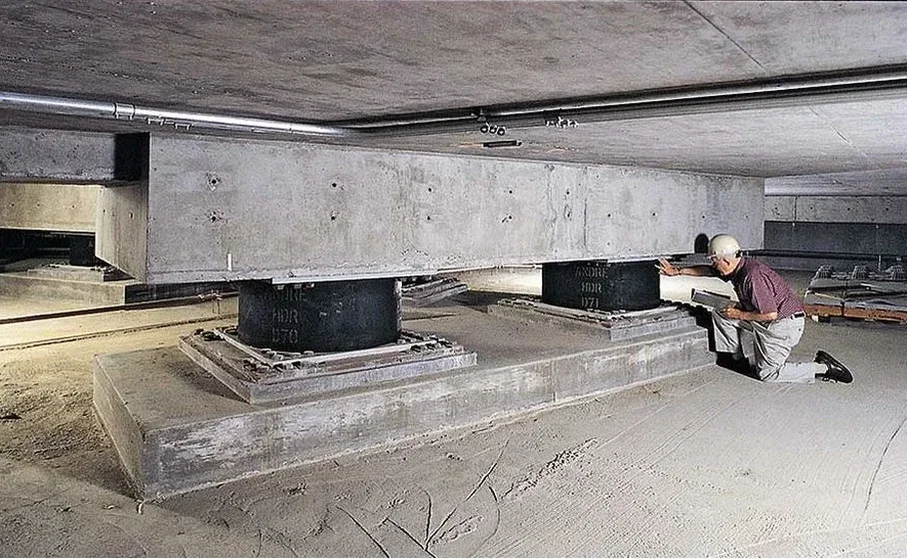
The isolation unit arrives on-site — a laminated elastomeric bearing, steel shim plates vulcanized within high-damping rubber. It is the core of a base isolation seismic design strategy. In Phoenix, we position these units between foundation and superstructure. This creates a flexible interface. The system decouples the building from ground motion. Spectral acceleration drops. Inter-story drift collapses to near zero. Our team handles everything from isolator characterization to installation oversight. We follow ASCE 7-22 Chapter 17 protocols. The Phoenix basin amplifies long-period waves. Isolation shifts the structural period beyond that amplification zone. A critical move for essential facilities. We often pair this with a liquefaction assessment when the site sits on the Salt River's old floodplain deposits. For projects near South Mountain's alluvial fans, understanding local soil dynamics through seismic microzonation refines the ground motion inputs before setting the isolator parameters.
Isolation shifts the structural period past 2.5 seconds, cutting spectral acceleration by up to 70% in Phoenix's deep basin site class D conditions.
Scope of work
Local ground factors
We see it on Phoenix job sites often: the assumption that distance from California faults means low risk. That assumption fails here. The 1887 Bavispe earthquake — magnitude 7.6 — caused damage in Phoenix, 200 miles from the epicenter. Basin amplification was the culprit. A fixed-base hospital on site class D soil here can see spectral accelerations that threaten functionality. A base isolation seismic design cuts that demand drastically. The alternative is a structural system that performs during the MCE but requires massive member sizes and still suffers nonstructural damage. Isolation protects the contents, the mechanical systems, the surgical suites. For public safety facilities, the lifecycle cost argument is overwhelming. Skip the isolation on a soft basin site and the post-earthquake inspection will find drift damage in every partition. The IBC requires Risk Category IV structures to meet a 1.5 importance factor — isolation makes that achievable without a 30% concrete premium.
Watch the video
Standards used
ASCE 7-22 Chapter 17: Seismic Isolation, IBC 2021 Section 1705.16: Seismic Isolation Testing, ASCE 7-22 Section 11.4: Site-Specific Ground Motion Analysis, ACI 318-19 Chapter 18: Earthquake-Resistant Structures
Related services
Isolator Characterization & Specification
We define upper and lower bound properties from prototype test data. Property modification factors for aging, temperature, and scragging get applied per ASCE 7. We write the procurement spec.
Nonlinear Time-History Analysis
Seven ground motion pairs, spectrally matched to the site-specific target. We run both upper and lower bound isolator models. Results include isolator displacement, base shear, and floor spectra for equipment design.
Peer Review & Testing Oversight
We prepare the design review package for the independent peer review panel. We witness prototype and production tests at the manufacturer's lab. Every bearing gets its acceptance criteria verified.
Typical parameters
Questions and answers
What is the cost range for a base isolation seismic design package in Phoenix?
For a typical essential facility in the Phoenix area, the structural design fee for base isolation seismic design ranges from US$4,130 to US$8,420. This covers nonlinear time-history analysis, isolator specification, and peer review coordination. The fee depends on building footprint, number of isolators, and complexity of the superstructure. The isolator hardware cost is separate and varies by manufacturer.
Which Phoenix buildings require seismic isolation per IBC?
The IBC mandates it as one option for Risk Category IV structures on site class D or E where spectral acceleration demands exceed certain thresholds. In Phoenix, this commonly applies to hospitals, fire stations, and emergency operations centers. Isolation is not the only compliance path — but it is often the most cost-effective for achieving immediate occupancy performance.
How do Phoenix basin effects influence isolator displacement?
Phoenix's deep sedimentary basin amplifies long-period ground motion. This pushes the isolator's effective period further to avoid resonance. The MCE displacement demand here can be 15-20% higher than a rock site with the same fault distance. Our analysis uses site-specific ground motions that capture basin surface waves. We do not rely solely on ASCE 7 generic spectra for final design.