The most common mistake on Phoenix-area projects is assuming the subsurface is uniform. Drill crews hit unexpected caliche layers, or groundwater shows up where the geotech report didn’t predict it. That’s where a vertical electrical sounding saves the project. A VES survey maps resistivity contrasts across depth—before the backhoe arrives—so you know whether that planned excavation will encounter cemented hardpan or saturated alluvium. In the Basin and Range province, where basin-fill sediments can shift from coarse gravel to fine clay within a few hundred lateral feet, relying on a single borehole alone is a gamble. We run a CPT test for cone resistance and pore pressure, and pair it with resistivity data to cross-check stratigraphy across the entire site. No guesswork, just a clear electrical profile that tells you what’s underground.
A single VES sounding in Phoenix basin fill can map four distinct resistivity units before you ever break ground.
Scope of work
Local ground factors
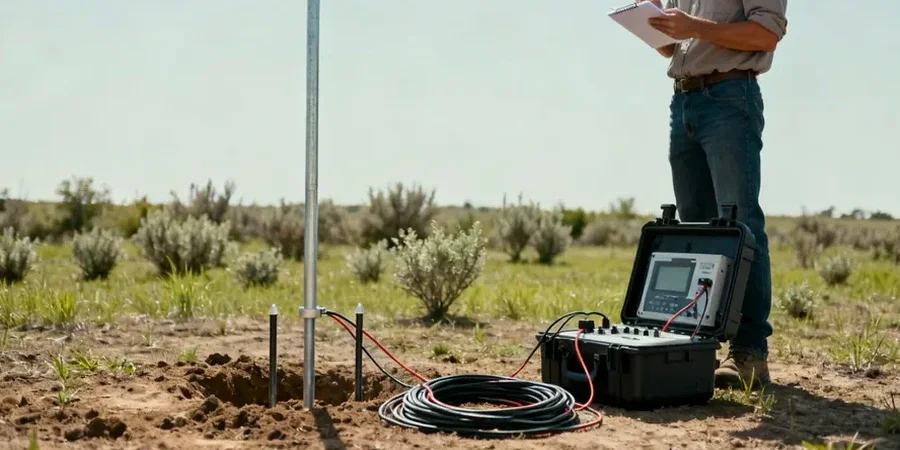
Phoenix recorded its hottest summer on record in 2023, with 31 consecutive days above 110°F. That heat isn’t just a comfort issue—it changes soil resistivity. Dry, baked surface soils can produce artificially high resistivity readings that mask a shallow water table or a clay lens below. If the crew doesn’t account for moisture loss in the upper few feet, the inversion model places bedrock too shallow, and the contractor specs the wrong excavation method. We run VES early in the morning when surface conditions are most stable, and we always soak the electrode stations in extremely dry conditions to reduce contact resistance. The other Phoenix-specific risk is urban noise. 60 Hz powerline interference and stray currents from nearby substations can distort the voltage measurement, especially at larger electrode spacings. Our resistivity meter filters 60 Hz noise and stacks multiple readings until the standard deviation drops below 3 percent, so the final profile isn’t contaminated by the city’s electrical grid.
Standards used
IBC Chapter 18 (Soils and Foundations), ASCE 7-22 Chapter 20 (Site Classification Procedure), ASTM D6431 (DC Resistivity for Subsurface Investigation), Arizona Administrative Code R18-9-110 (Aquifer Protection Permit requirements, where applicable)
Related services
Standard VES Site Survey
A single or multi-station Schlumberger sounding with 1D inversion, depth-to-bedrock interpretation, and a resistivity cross-section aligned to your site grid. We include correlation with any existing geotechnical boring logs you carry out.
Resistivity Profile for Groundwater Exploration
Targeted VES transects for locating the water table or perched saturated zones in basin-fill sediments. Output includes interpreted depth to saturation and estimated formation resistivity for well-screen design decisions.
Typical parameters
Questions and answers
What does a resistivity survey in Phoenix cost?
For a typical single-station VES sounding on a residential or light commercial lot in the Phoenix metro area, expect a range of US$620 to US$1,100. The price depends on the maximum depth required, the number of soundings, and site accessibility. Multi-station transects for larger subdivisions or groundwater exploration are quoted per project.
How do you deal with the desert soil conditions?
Dry surface soil creates high contact resistance that can degrade data quality. We pre-wet electrode positions and use bentonite mud at each stake when conditions are extremely dry. We also schedule fieldwork for early morning hours during summer to minimize the effect of surface heating on the resistivity readings.
How does VES compare to drilling a test pit?
A test pit gives you direct visual inspection of the upper 15 feet. A VES sounding gives you a continuous electrical profile down to 300 feet or more without disturbing the ground. They answer different questions. VES tells you where the water table and bedrock are; the test pit confirms the shallow stratigraphy. We often use both on the same project.
Can you run resistivity surveys in urban Phoenix with all the powerlines?
Yes. Our resistivity meter has built-in 60 Hz noise rejection and stacking capability. We monitor the standard deviation of the voltage measurement in real time and increase the number of stacks in noisy areas until the data stabilizes. When a site is directly under a high-voltage transmission corridor, we adjust the array orientation to minimize coupling and note the interference in the final report.