Anyone who has worked on underground infrastructure in Phoenix knows the Salt River Valley doesn't just present hard caliche. Much of the basin is filled with deep sequences of interbedded silts, clays, and poorly consolidated sands that pose serious challenges for tunnel boring. The city sits at about 1,086 feet elevation in a geologically young basin, and these soft alluvial deposits create face instability and squeezing ground conditions that standard rock mechanics don't address. Before a single foot of advance, owners and contractors need a precise geotechnical analysis for soft soil tunnels to map the transition zones between stiff and yielding materials. We often pair this with a CPT test to get a continuous profile of soil behavior type, and with grain size analysis to quantify the fines content driving squeezing potential. The goal is simple: avoid costly standstills and keep the cutterhead turning through Phoenix's most unpredictable ground.
In Phoenix's basin fill, the difference between a successful drive and a collapse is often found in a single silt seam that standard borehole logging missed.
Scope of work
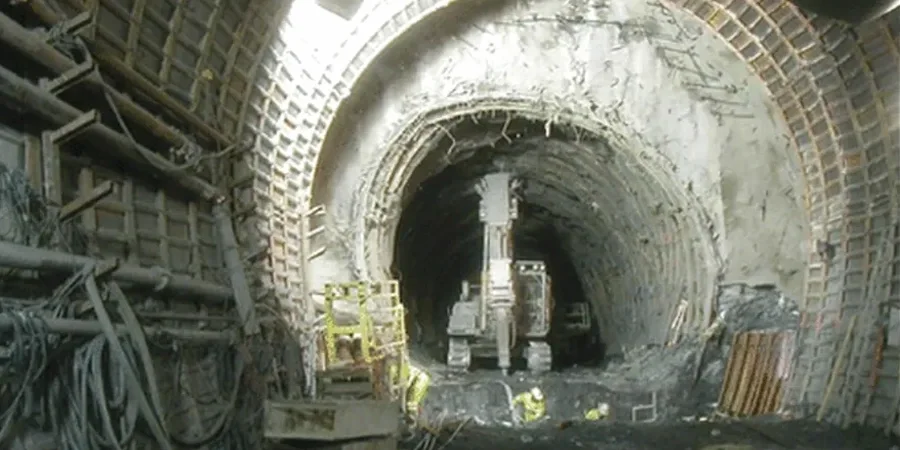
Key technical aspects we always include: assessment of stand-up time in silty clay lenses, face pressure requirements for EPB machines, and the influence of nearby buried paleochannels on alignment stability and groundwater inflow.
Local ground factors
With over 1.6 million people in the metro area, a tunnel failure in Phoenix isn't just an engineering problem—it's a public safety and liability crisis. The primary risk in soft soil is the development of a chimney failure that propagates to the surface, especially in the loosely consolidated upper 20 feet of the valley fill. Differential settlement can fracture water mains and gas lines long before the tunnel reaches them. There's also the issue of heave at the invert if the support pressure is miscalibrated. Groundwater, though often deep, can be perched within clay layers and cause sudden face collapse when intercepted. The geotechnical analysis for soft soil tunnels mitigates these risks by defining strict operational parameters for face pressure and annular grouting, directly informed by site-specific consolidation testing and effective stress analysis. This isn't a one-size-fits-all job; it's a tailored solution for Phoenix's unique basin stratigraphy.
Standards used
ASCE 7-22 Minimum Design Loads, IBC 2024 Chapter 18 Soils and Foundations, ASTM D1586 Standard Test Method for SPT, ASTM D2487 Unified Soil Classification System
Related services
Tunnel Face Stability and Settlement Analysis
We use finite element and analytical methods to predict face extrusion and surface settlement in Phoenix's interbedded clays and silts. The analysis calibrates EPB or slurry shield pressures to avoid blowout in shallow cover sections near the canal system.
Soft Ground Pre-Support and Grouting Design
In portal areas and mixed-face transitions, we design pre-support using grouting and dewatering strategies. The focus is on controlling ground loss before it reaches critical infrastructure in dense urban corridors of Phoenix.
Typical parameters
Questions and answers
What is the typical cost range for a geotechnical analysis for soft soil tunnels in Phoenix?
The investment for a comprehensive soft soil tunnel analysis in the Phoenix area typically ranges from US$4,810 to US$19,200. The final cost depends on the linear footage of the tunnel, the number of boreholes required, the complexity of the lab testing program, and whether advanced numerical modeling is needed for the specific alignment.
How does Phoenix's soil differ from hard rock tunneling conditions?
Unlike the hard granite found north of the city, Phoenix's basin is filled with alluvial deposits—sands, silts, and clays. These materials exhibit time-dependent deformation and require analysis focused on undrained strength and consolidation rather than rock mass rating. The ground tends to squeeze and converge, demanding a very different support strategy.
Which lab tests are critical for designing a soft soil tunnel here?
The most critical tests target low-strength materials. We emphasize consolidated-undrained triaxial tests with pore pressure measurement, one-dimensional consolidation to estimate settlement magnitude and rate, and Atterberg limits to correlate with squeezing potential. Grain size distribution also plays a key role in assessing face conditioning needs.
Can you analyze the risk of sinkholes or surface collapse during boring?
Yes, chimney stability analysis is a standard part of our scope. We evaluate the potential for a void to propagate upward through the unsaturated silts and sands common in Phoenix's near-surface geology. The analysis defines the minimum required face pressure and the necessary backfill grouting timing to prevent such failures.