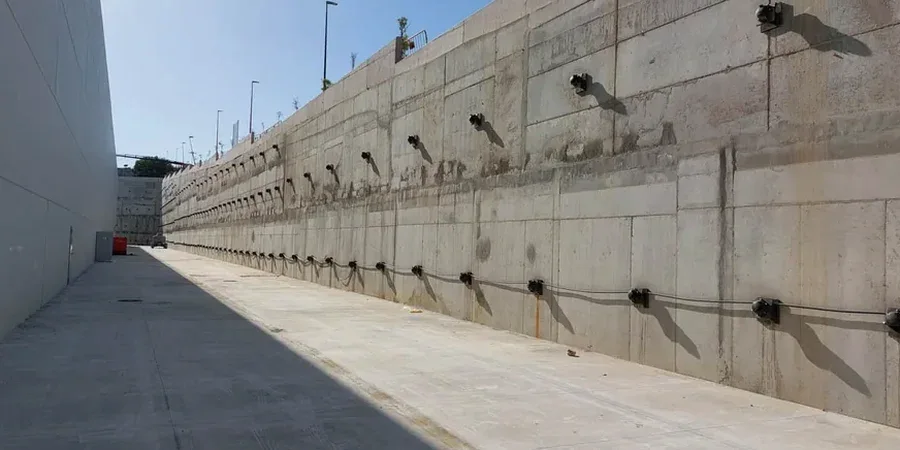
A recent excavation near the Salt River channel exposed a classic Phoenix profile: hard caliche over dense, cemented alluvium. The contractor had planned 60-foot tiebacks but hit refusal at 18 feet, a scenario we see across the Valley of the Sun. Phoenix soils, shaped by millions of years of basin fill and sporadic cementation, demand anchor systems that adapt to sharp stiffness contrasts. Our active/passive anchor design combines coring through the hardpan with bond length optimization in the underlying sandy gravels. Before mobilizing, we often run a CPT test to map the exact depth of the caliche, followed by a grain-size analysis on cuttings to verify friction assumptions. With 1.7 million people living in a basin where bedrock can be 10,000 feet deep, every anchor solution must be tailored to the specific cementation profile encountered on site.
An anchor is only as reliable as the bond length embedded in competent material; in Phoenix, identifying that material requires penetrating the caliche.
Scope of work
- isolating the unbonded length through caliche to prevent load transfer outside the design zone
- specifying neat cement grout with water-cement ratios between 0.40 and 0.45 for the bonded section
- verifying load-holding capacity with incremental loading and unload cycles before final lock-off
Local ground factors
Phoenix's explosive growth since the 1950s transformed irrigated farmland into dense subdivisions and commercial corridors. Much of the urban core sits on former agricultural land where decades of flood irrigation altered the near-surface soil chemistry, accelerating cementation in some blocks while leaving adjacent parcels surprisingly loose. Relying on a single anchor design without verifying subsurface continuity across the entire shoring alignment creates a risk of differential movement. We have investigated failures where a passive anchor installed in apparently competent material lost capacity because the bond zone intersected an uncemented lens. The cost of a pull-out failure during excavation can easily exceed the entire testing budget. Our verification protocol requires systematic load testing on 5% of production anchors and 100% of the initial test anchors, correlating results with the stratigraphy logged during test pits to confirm that the design assumptions hold across the site.
Standards used
IBC 2021 Section 1810, ASCE 7-22 Chapter 3, PTI DC35.1-14 Recommendations for Prestressed Rock and Soil Anchors, ASTM D1586 Standard Penetration Test, ASTM D2487 Soil Classification
Related services
Active Tieback Design
Prestressed anchors for deep excavations where lateral displacement control is critical, with lock-off loads calculated per active earth pressure diagrams.
Passive Anchor Systems
Non-prestressed solutions for retaining walls and slope stabilization, activated by soil movement within allowable deformation limits.
Load Testing & Verification
Performance, proof, and extended creep tests on instrumented anchors, with real-time data acquisition and compliance reporting.
Corrosion Protection Design
Double-corrosion protection for permanent anchors in Phoenix's alkaline soils, including epoxy-coated strands and corrugated sheathing per PTI guidelines.
Typical parameters
Questions and answers
What is the difference between active and passive anchors?
Active anchors are prestressed to apply a calculated force to the retaining structure before any soil movement occurs, controlling deformation from the start. Passive anchors develop their resistance only when the soil begins to move; they are typically used where some displacement is tolerable, such as in temporary shoring or less sensitive structures. In Phoenix's cemented soils, active anchors often require longer unbonded lengths to ensure the lock-off load is transferred into competent material well behind the potential failure plane.
What does active/passive anchor design cost in Phoenix?
A complete design package for a typical Phoenix shoring project, including subsurface investigation correlation, anchor load calculations, bond length optimization, and load testing specifications, ranges from US$1.130 to US$3.740 depending on the number of anchor levels and the complexity of the soil profile. Projects requiring extensive caliche coring or multiple test anchor programs fall toward the upper end of that range.
How do caliche layers affect anchor performance in the Phoenix area?
Caliche, a calcium carbonate cemented zone common in Phoenix at depths between 5 and 25 feet, acts as a natural concrete that can cause auger refusal and complicate drilling. For anchor design, the caliche must be cased through or cored to prevent load transfer above the design bond zone. Once penetrated, the underlying cemented alluvium provides excellent bond capacity, often exceeding 15 psi ultimate unit bond stress based on our load test records in the central Valley.