A warehouse expansion near the Salt River hit refusal at 3 feet. Caliche. Below that, loose alluvium with SPT blow counts under 5. The structural loads required 4,000 psf bearing capacity. Native soil gave less than half. We see this pattern across Phoenix. Collapsible silty sands and pockets of uncontrolled fill from decades-old agricultural grading create real foundation challenges. Stone columns bridge that gap. By replacing 15 to 30 percent of the weak matrix with compacted gravel, we shift the composite modulus into workable range. No overexcavation. No deep piles. The method works fast on sites where groundwater is deep enough to allow dry bottom-feed installation. For sites with variable stratigraphy we often pair the layout with a CPT test to pinpoint the depth to competent bearing material and refine the column length before mobilization.
Stone columns don't just densify loose soil. They create a composite mass with a predictable modulus that we can model in PLAXIS or FLAC before the first rig arrives on site.
Scope of work
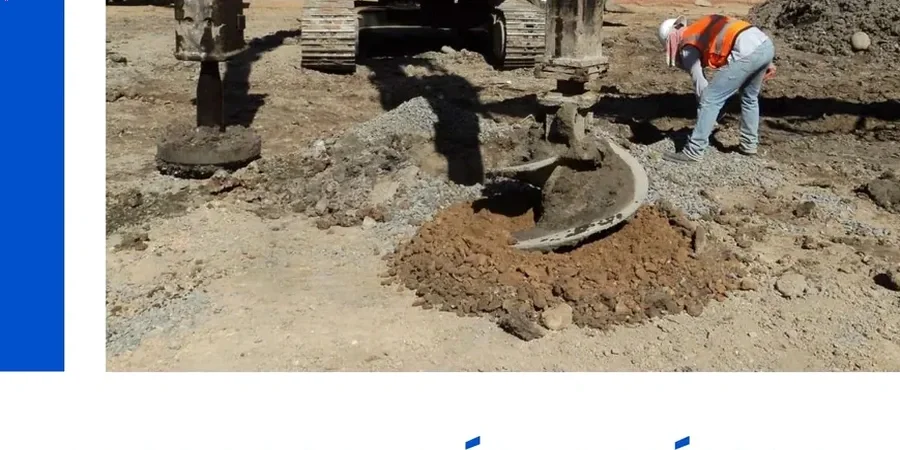
Local ground factors
We see a specific failure mode in Phoenix that doesn't appear in the textbook. The client approves stone columns. The design assumes homogeneous loose sand. But the boreholes missed a 2-foot-thick gypsiferous layer at 18 feet. The vibrator punches through it. Later, irrigation water dissolves the gypsum. Voids form. The column loses lateral confinement and settlement resumes where it shouldn't. That's why our scope always includes a second look at the cuttings. If we see white crystalline fragments, we stop and re-evaluate. Another risk is overestimating the improvement ratio in silty soils. Fines dampen the vibratory energy. Without careful quality control, the column diameter shrinks below design. We log amperage and stone volume per linear foot on every column. No exceptions. In areas of Phoenix with high sulfate soils we also specify Type V cement in any grout caps to avoid ettringite expansion.
Standards used
ASTM D1586 – Standard Test Method for Standard Penetration Test (SPT), ASTM D2487 – Classification of Soils for Engineering Purposes, ASCE 7 – Minimum Design Loads for Buildings and Other Structures, IBC Chapter 18 – Soils and Foundations, FHWA-NHI-16-027 – Ground Improvement Methods (Reference Manual)
Related services
Preliminary Feasibility and Design
We review existing borings or drill new ones. Then we run settlement and bearing capacity analyses in Settle3 or equivalent software. The deliverable is a design memorandum with column diameter, grid spacing, depth, aggregate spec, and estimated post-treatment modulus.
Construction-Phase Quality Control
We deploy a field engineer to monitor amperage records, stone consumption, and lift thickness on every column. We perform modulus verification with plate load tests or post-treatment CPT soundings per ASTM standards.
Typical parameters
Questions and answers
What does stone column design cost for a typical Phoenix commercial lot?
Design fees for a standard commercial lot in Phoenix run between US$1,280 and US$5,360. The range depends on the number of borings we need to review, the complexity of the loading, and whether we run 3D finite element analysis or a simpler unit-cell model. A small retail pad with uniform soil and light column loads sits at the lower end. A tilt-up warehouse with heavy rack loads and variable fill sits at the upper end.
Are stone columns effective in Phoenix caliche layers?
It depends on the caliche thickness and fracture pattern. Thin, fractured caliche can be penetrated with a predrilled pilot hole and then treated with stone columns below. Massive caliche thicker than 4 feet usually stops vibroflotation. In those cases we design a hybrid solution: shallow footings on the caliche with stone columns installed through predrilled holes where the caliche pinches out.
How do you verify that the stone columns meet the design specification?
We use three verification methods. During installation the rig logs amperage and stone volume per linear foot. After curing we run plate load tests on sacrificial columns to measure the modulus directly. On larger projects we also perform post-treatment CPT soundings between columns and compare the tip resistance to the design target. All data goes into a report with pass/fail criteria tied to the project specifications.