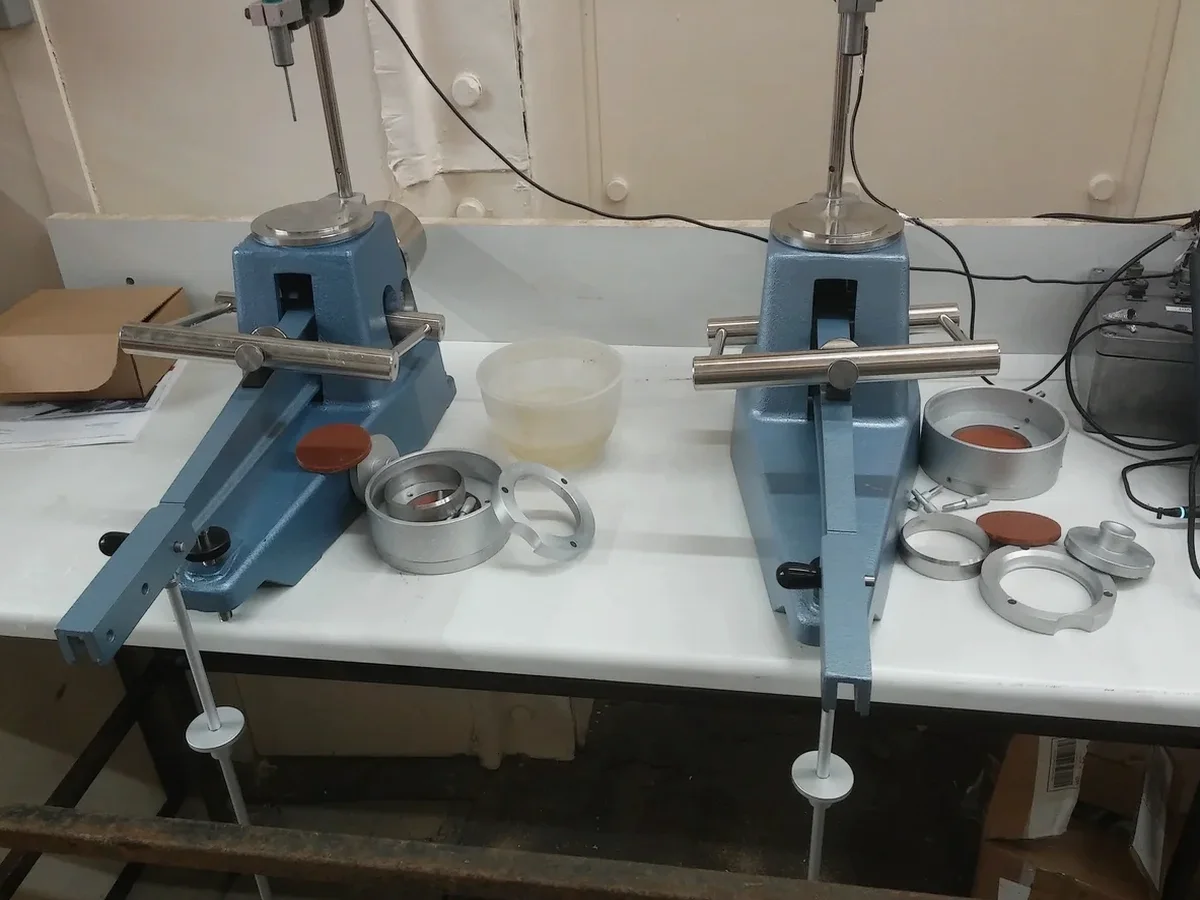
A contractor breaking ground near South Mountain recently called us after hitting a lens of gray clay that turned slick the moment water touched it. The material felt like modeling clay, and the excavator bucket kept balling up. That's textbook behavior for a soil with a high plasticity index, and in Phoenix, where basin-fill sediments alternate between coarse alluvium and fine lake-bed deposits, these surprises are more common than many engineers expect. Running Atterberg limits on that sample gave us the numbers we needed to advise on moisture conditioning and to confirm the clay's USCS classification. Whether you're dealing with the caliche-rich gravels of Scottsdale or the silty clays near the Salt River channel, quantifying the transition between semi-solid, plastic, and liquid states is fundamental to predicting how your subgrade will perform under load and through Phoenix's intense wet-dry cycles. Often we pair this index testing with a grain size analysis to build a complete physical characterization of the material before it goes into the structural design.
A plasticity index above 20 in Phoenix basin clays signals shrink-swell behavior that must be addressed in foundation and pavement design.
Scope of work
Local ground factors
Phoenix's post-war expansion pushed residential and commercial development across vast swaths of former flood-irrigated farmland, particularly in areas like Maryvale and parts of Tempe and Mesa. In these zones, the near-surface clays have been subjected to decades of wetting and drying cycles that fundamentally alter their Atterberg behavior. We've pulled Shelby tube samples from a depth of six feet where the natural moisture content was near the plastic limit, yet just three feet higher, a desiccated crust showed a liquidity index below zero, indicating a brittle, overconsolidated state. Ignoring the plasticity profile means risking differential heave under a slab: the hydrated clay swells, the desiccated crust doesn't, and the resulting movement cracks walls and binds doors. The IBC and ASCE 7 provisions for expansive soils directly reference the Atterberg limits as a trigger for special foundation requirements. A fifteen-minute test on a disturbed sample can save tens of thousands in structural repairs down the road.
Standards used
ASTM D4318 - Standard Test Methods for Liquid Limit, Plastic Limit, and Plasticity Index of Soils, ASTM D2487 - Standard Practice for Classification of Soils for Engineering Purposes (Unified Soil Classification System), ASCE 7 - Minimum Design Loads and Associated Criteria for Buildings and Other Structures (Expansive Soil Provisions), IBC (International Building Code) - Chapter 18: Soils and Foundations
Related services
Expansive Soil Evaluation
We combine Atterberg limits with natural moisture content profiles and swell-consolidation testing to quantify potential vertical movement. This package directly supports the design of post-tensioned slabs, drilled piers, and moisture barrier systems per IBC Section 1805.
Pavement Subgrade Classification
For roadway and parking lot projects, we use the plasticity index and gradation to assign an AASHTO group classification and determine the design CBR or resilient modulus. Phoenix DOT projects often require this data before approving structural section designs.
Forensic Geotechnical Investigation
When a structure shows distress, we sample the foundation soils and run Atterberg limits to compare current plasticity characteristics with those assumed during design. Changes in the moisture regime, often from landscape irrigation, can shift a soil's behavior from stable to expansive over a period of years.
Typical parameters
Questions and answers
How much does Atterberg limits testing cost in Phoenix?
For a single disturbed sample, Atterberg limits testing (liquid limit, plastic limit, and plasticity index) typically runs between US$50 and US$90. Most projects require testing on multiple samples taken from different depths and locations, so the total cost scales with the number of samples submitted. We carry out a firm quote once we know the boring or test pit layout.
How long does it take to get Atterberg limits results?
Standard turnaround is 2 to 4 business days from the time the sample arrives at our lab. We also offer a 24-hour expedited service for projects on a tight schedule. The drying and soaking steps required by ASTM D4318 set a minimum practical time, but we prioritize rush requests when contractors are waiting on a foundation recommendation.
Can you classify the soil type just from the Atterberg limits?
The liquid limit and plasticity index allow us to assign a USCS group symbol (CL, CH, ML, MH, etc.) using the plasticity chart in ASTM D2487, but a complete classification also requires a grain size distribution. We typically request that you run both Atterberg limits and a sieve and hydrometer analysis on the same sample for a definitive classification.
What do the Atterberg limits tell me about expansive soil risk?
The plasticity index is the key number. Soils with a PI below 15 generally have low swell potential, while those above 25 can produce significant heave when moisture increases. In Phoenix, we also look at the liquidity index and the soil's activity (PI divided by clay fraction) to gauge how sensitive the material is to changes in water content. These values guide decisions on over-excavation depth, lime treatment, and foundation type.